What Size Telehandler Do You Need For Your Event?
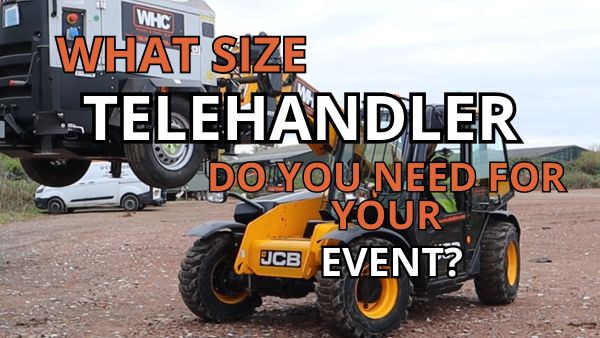
If you find yourself scratching your head wondering how the most reputable event organisers always seem to know exactly what size equipment they need before they load out, you’re not alone. Especially when it comes to hiring equipment such as a telehandler, a piece of kit that is often over seen until it’s needed most.
The truth is, simply picking any available machine is not the answer. More often than not, the difference between a smooth event build and a costly one comes down to a single decision made weeks before build day.
Whether you’re planning a music festival, outdoor expo, or large-scale event, choosing the right telehandler could be the difference between an efficient, safe operation and unnecessary delays during your delivery and build phase.
Telehandlers are one of the most versatile pieces of plant machinery available for event hire. But with so many different designs, sizes, lift heights, and load capacities, selecting the right one can feel more like rocket science than a straightforward choice. With a little forward planning and the help of this guide, you’ll have everything you need to hire with confidence.
Why Telehandler Size Matters at Events
Hiring the wrong size telehandler for your event build doesn’t just cause operational issues. It can set off health and safety alarms. A machine that is too small may not have the reach to position stage roofing sections correctly, the lift capacity to load or unload heavy pallets and barrier systems, or the right specification for the terrain you’re operating on.
However, simply hiring a machine that is too large doesn’t necessarily solve the problem either. Oversized machinery can lead to potential access difficulties and make manoeuvring in tight backstage areas far more challenging than it needs to be. Not to mention the unnecessary hit to your equipment budget.
Getting the right-sized machine is the answer to keeping your stage and structure builds on schedule, and ensuring your teams are working within the safe operating limits of the equipment at all times. In short, it means having exactly what your crew needs to work efficiently and safely at every stage of your event. To find out more about how telehandlers can transform your event delivery, take a look at our article How Telehandlers Speed Up Event Build Times.
Here are the key considerations you should be making when selecting the right size telehandler for your event.
What Will You Be Lifting? Understanding Load Weight
The starting point for choosing the right size telehandler for your event crew is understanding the heaviest single load you’ll need to lift. At events, this could be as straightforward as unloading pallets of equipment or crowd barriers, ranging up to around 1 tonne. For larger stage components, you may require something far more substantial. The key is choosing the most suitable option that comfortably covers your heaviest requirement.
Common loads on event sites include:
- Staging decking and roofing sections (up to 3 tonnes)
- PA speaker stacks and audio towers (up to 1 tonne)
- Lighting rig trussing and ground support structures (1 tonne and above)
- Generators and power distribution equipment (500kg upward)
- Marquee frame sections (up to 1 tonne)
- Catering and welfare unit pallets (up to 1 tonne)
- Fencing, barrier systems, and temporary infrastructure (up to 1 tonne)
For event organisers, it is important to remember that a telehandler’s rated capacity is its maximum lift at ground level with the boom fully retracted. As the boom extends and rises, safe working capacity reduces significantly. Every telehandler is fitted with a load chart specific to that machine, and referring to it before any lift will help you factor in an appropriate safety margin above the weight of the heaviest load your crew will be handling.
How High Do You Need To Reach? Telehandler Lift Height Explained
One of the key reasons many event organisers opt to hire a telehandler is their ability to position equipment and materials at height without ever leaving the ground. When it comes to choosing the right size machine, the height you need to reach will be determined by the structures being built on site. As a general guide:
- Compact stages (6m to 8m roof height): a machine with a lift height of around 8 to 10 metres is usually sufficient
- Medium festival stages (up to 12m roof height): a telehandler with a lift height of 12 to 14 metres is recommended
- Large main stages (14m and above): a high-reach telehandler with a lift height of 14 metres or above is required
It is worth noting that the maximum lift height is calculated in a machine’s specification with the boom fully extended and near-vertical, at minimum forward reach. In real working conditions, usable height is often slightly lower, particularly when an attachment is fitted or the lifting position is slightly forward of the machine. To ensure you get the right specification for the job, we strongly recommend discussing your exact requirements with your hire specialist rather than relying on headline figures alone.
How Far Does The Load Need To Travel? Boom Reach
The forward reach of a telehandler is one of the key differences that sets this piece of equipment apart from a traditional forklift. On event builds, this capability makes them a particularly strong choice. The telescopic boom extends outward, allowing loads to reach over obstacles or into positions that would otherwise be difficult or impossible to access.
On event builds, forward reach matters when:
- Loading materials over crowd barriers or perimeter fencing
- Placing equipment behind stage sets or production structures
- Lifting and unloading loads from vehicles and repositioning them without the machine needing to move closer
- Working in tight access areas where the machine cannot get directly underneath the target position, such as between temporary structures
As with lift height, forward reach and load capacity work in tandem. The further the boom extends, the lower the safe working capacity. This is essential to understand when lifting heavier loads at or near full reach. Always refer to the specific machine’s load chart, which sets out the relationship between height, reach, and maximum safe load for that piece of equipment. If you are unsure at any point, we strongly recommend seeking guidance from your event equipment hire supplier before the lift takes place.
What Are The Ground Conditions At Your Event Site?
Ground conditions are a factor that many event organisers frequently underestimate, particularly on longer projects where adverse weather can change the site underfoot almost overnight. Most events take place on grass fields, parkland, private estates, or temporary surfaces that can present real challenges for heavy machinery such as telehandlers.
When ground becomes soft, waterlogged, or less stable, it directly affects how a telehandler performs and what level of stability you can expect during operation. While telehandlers available from your event equipment hire supplier generally suit all-terrain use, there are situations where you may require additional measures to ensure safe operation.
When assessing ground conditions at your site, consider the following:
- Soft or boggy ground: can affect the stability and traction of the machine, particularly when operating under heavy load.
- Slopes or uneven terrain: gradients affect the safe working use of a telehandler. If your site has any significant incline, ask your hire specialist to confirm the machine is suitable for that gradient.
- Temporary roadways: if your site has a temporary road or access route, it is essential to be aware of its load-bearing capacity. Failing to account for this can lead to ground subsidence and potential problems with site access.
- Hard standing areas: concrete or tarmac surfaces offer the best load-bearing capacity and traction. However, be aware of service routes and utilities beneath the surface before operating heavy plant.
If your site has challenging ground conditions, speak directly to your hire specialist before confirming your equipment. Selecting a machine with the wrong tyre specification, or without appropriate additional measures in place, can cause damage to the site and compromise the safety of your operators.
How Much Space Do You Have To Work In?
All event sites are extremely busy places. Backstage corridors, production compounds, and loading bays are often far tighter than they first appear on a site plan. The physical dimensions of the telehandler you hire are therefore just as important as its lift specification. It is not just about what the machine can lift, but how it moves around site between tasks.
As a starting point:
- Compact telehandlers offer far greater manoeuvrability and suit confined spaces, narrow access routes, and sites with limited working space.
- Full-size and large telehandlers offer greater capacity and reach but require significantly more space to reposition and operate safely
One of the practical advantages of modern telehandlers is that they are equipped with multiple steering modes, helping operators navigate tight access areas with greater ease. Whether you are opting for a compact or full-size machine, it is worth confirming that the model you hire offers this function before your build day.
Take a look at the video below:
When planning site logistics, think about access gate widths, turning radius between structures, and proximity to other contractors, vehicles, and the public. Exclusion zones around operating plant are a legal requirement. Plan for them in advance.
What Attachments Do You Need?
If you were not already aware, one of the reasons telehandlers are so popular on event sites is the range of attachments they support. These quickly transform the machine from a simple forklift into a multi-purpose tool, and one that remains useful well beyond the initial set up stage. It is important to understand, however, that the attachments you require will directly influence the size of machine you need and its effective load capacity.
Common telehandler attachments used at events include:
- Pallet forks: used for the majority of loading and unloading tasks, as well as transporting palletised loads around site during set up and breakdown.
- Basket: allows operators to be lifted safely to height for rigging, lighting installation, and banner hanging. The lift capacity must account for not just the basket itself, but the operators and any equipment being carried.
- Lifting hook: used with chains or slings for lifting loads across multiple lift points, particularly useful for long or awkward stage structures.
- Bucket: used for shifting loose materials in and around the event site, removing the need for additional machinery such as a dumper.
Every attachment adds weight to the machine, which in turn reduces the load capacity available for the task. When specifying the telehandler you need with your event equipment hire provider, always factor in the weight of any attachments alongside the weight of the load being lifted.
Telehandler Size Hire Guide For Event Tasks
Every event is different, each with its own specifications, tasks, and requirements. The table below gives you a practical starting point when considering which size telehandler is likely to best suit your build. Always confirm specific loads, heights, and site conditions with your hire specialist before committing to a booking.
| Event Type | Common Load | Lift Height | Recommended Capacity | Machine Class |
| Community Fete/ Village Show | Marquee poles, generators, PA system | Up to 6m | 2.5 Tonne | Compact Telehandler |
| Outdoor Event Private Wedding/ Party | Marquee Structure, Furniture, Pallets | Up to 8m | 2.5- 3.5 Tonne | Compact- Small Telehandler |
| Corporate Event/ Brand Activation | Stage Sections, AV equipment, Small Rigging, Branded Structures | Up to 10m | 3.5 Tonne | Mid-range telehandler (Location Specific) |
| Music Festival (Small – Medium) | Stage Building, AV equipment, trussing, speaker towers, barrier systems | Up to 14m | 4- 6 Tonne | Full-sized telehandler |
| Large-scale festival/arena event | Main stage roof sections, heavy production rigging | 14m+ | 6 tonne+ | Full-sized telehandler fitted with outriggers. |
For larger events with multiple stages or activity areas, it is worth considering whether more than one telehandler is required. Having a mix of sizes allows equipment to be utilised effectively across all stages of event delivery. A compact machine is ideal for general site logistics and day-to-day material movement, while a high-reach model is better suited to stage builds and heavier lifting tasks.
Do You Need An Operator With My Telehandler Hire
For many event organisers, the question of whether an operator is needed with your hire is one we get asked regularly. The truth is, you do not need a telehandler licence to hire a machine. However, anyone operating a telehandler in a professional or commercial setting must be able to demonstrate that they are competent to do so. For more information, take a look at our safety and compliance section in our Ultimate Guide to Telehandler Hire.
The two most widely recognised schemes in the UK are:
- CPCS (Construction Plant Competence Scheme): the most common qualification on construction and event sites, with a blue trained operator card and a red competent operator card
- NPORS (National Plant Operators Registration Scheme): a widely accepted alternative across the events and construction industries. We recommend Vally Plant Training for anyone looking to get qualified
Some events and site management teams will require operators to provide evidence of competency before allowing them to use a telehandler on site. Always check this requirement before hiring, otherwise you could find yourself paying for equipment you are unable to use on the day.
Do’s & Don’ts Of Telehandler Hire For Events: Overview
| Do | Do Not |
| Confirm the heaviest load you need to lift before hiring. | Assume the headline capacity applies to the full boom extension. |
| Consider ground conditions at your site and plan accordingly. | Operate a telehandler on soft ground without checking stability first. |
| Factor in attachment weight when calculating load capacity | Use a machine that is insufficient to save on hire cost. |
| Ensure the operator is competent to operate the equipment. Holding a CPCS or NPORS card. | Allow incompetent, untrained operators to use the equipment. |
| Plan the site layout and access routes before the machine arrives. | Underestimate the space a full-size machine needs to manoeuvre. |
| Leverage your supplier knowledge on equipment specifications and machine recommendations. | Guess the right specifications when help is available from your provider. |
Safety Considerations When Using A Telehandler at Events
When operating a telehandler at an event, the responsibilities extend well beyond those of a standard construction environment. Public presence, temporary structures, and live performances make safe working practices not just important, but essential.
Key safety considerations include:
- Exclusion zones: establish clear working areas around any machinery in operation and communicate these to all contractors on site at every phase of the event
- LOLER compliance: any lifting operation using a telehandler is subject to the Lifting Operations and Lifting Equipment Regulations 198 (LOLER). Ensure the telehandler you hire has an up to date LOLER inspection certificate that can be produced on request
- Pre-operational checks: before each use, operators should carry out a full pre-operational inspection of the machine, covering visual condition, fluid levels, safety systems, and operational functions
- Load charts: ensure the machine’s load chart is present and visible in the cab and is referred to before every lift
- Communication: use radios or agreed signal protocols between the operator and banksmen on the ground, particularly when lifting loads to height or over obstacles
- Overhead hazards: during the planning phase, check for overhead power lines, temporary lighting rigs, and other aerial obstructions before the machine’s boom is operated on site
Ready To Hire A Telehandler For Your Event?
Choosing the right telehandler for your event comes down to understanding the specific demands of your project. What you are lifting, how high, in what conditions, and with what attachments. Getting that decision right from the start saves time on site, reduces risk, keeps your build on schedule, and ensures you get the best possible value from your hire.
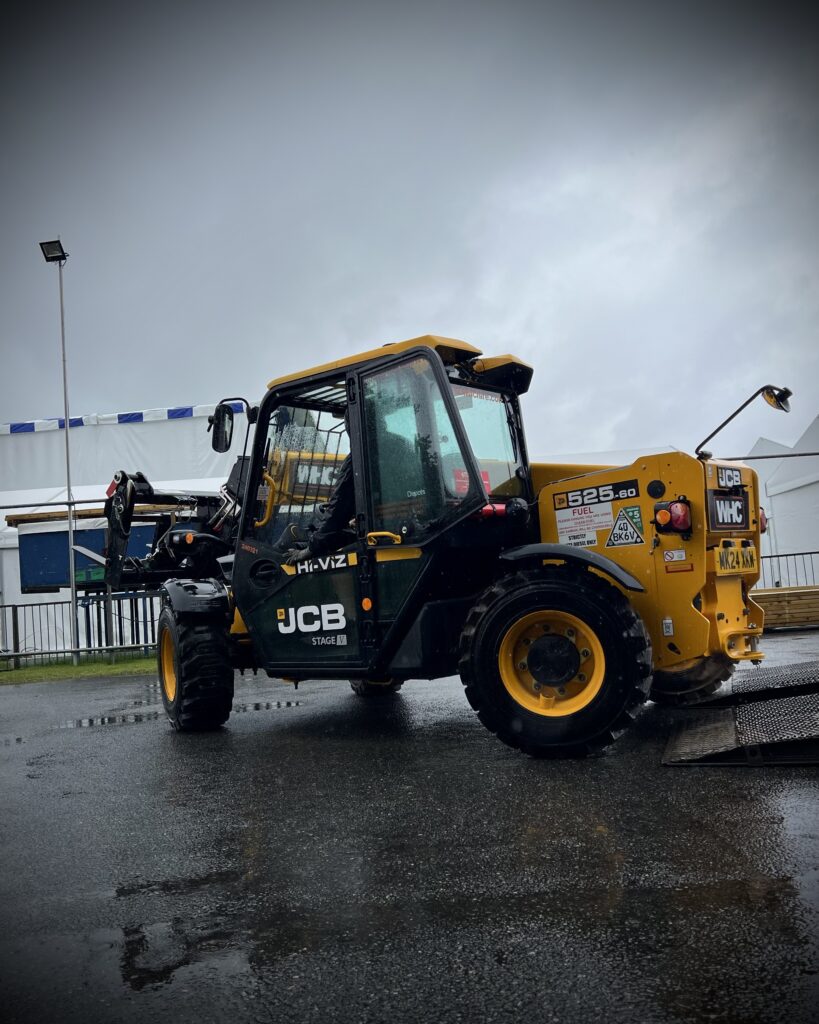
At WHC Hire Services, we have been supplying event organisers and venues across Worcestershire, Gloucestershire, and Oxfordshire since 1997. Our fleet of JCB telehandlers covers a wide range of sizes and specifications, from compact units ideal for general site logistics through to larger, full-size heavy-duty machines built for the most demanding stage builds. Backed by a highly knowledgeable team, we are on hand to help you find the right machine for your event.
Get in touch with the team today to discuss your event equipment hire requirements and get expert advice on the right specification for your build.