
What is Roller Compaction?
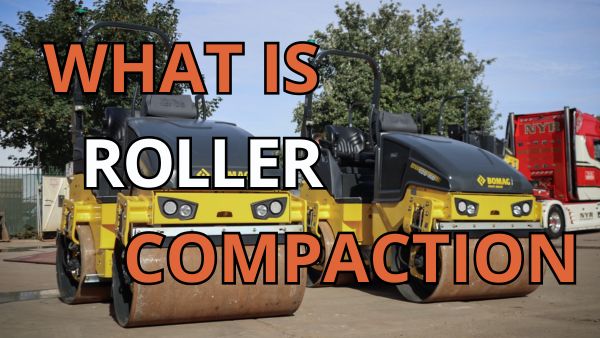
Roller compaction is a critical stage in many construction and groundworks projects, used to increase soil density, improve load-bearing capacity, prevent subsidence, and enable the construction of stable bases for roads, driveways, foundations, and landscaping features such as ponds, lakes, and other waterways.
Whether you are undertaking a small domestic project or working as part of a large-scale civil engineering development, understanding the fundamentals of roller compaction puts you several steps ahead. Getting this stage right is essential for developing long-lasting surfaces, rather than ones that fail prematurely due to poor ground preparation.
Put simply, roller compaction uses the downward pressure and controlled motion of a roller compactor to remove air pockets from between soil, aggregate, or asphalt layers. By eliminating these voids, the material becomes denser, stronger, and more tightly bound. This results in a surface that better resists movement, erosion, and water penetration over time.
For this reason, roller compaction is a standard requirement across the construction industry. It provides the structural integrity needed to support imposed loads while maintaining compliance with modern building standards.
One of the most important roles roller compaction plays is in meeting specific engineering specifications and building regulations. When compaction is carried out correctly, projects can progress with fewer delays, reduced remedial work, and a significantly increased lifespan of the finished surface. Professional roller hire plays an essential role in this process, providing access to the correct machinery needed to achieve required compaction rates and regulatory compliance on site.
How Do Roller Compactors Work?
Roller compactors work by applying controlled pressure to the ground through a combination of machine weight, rolling motion, and, in many cases, vibration. As operators pass the roller over the surface area, air pockets trapped between soil or aggregate particles are forced out, allowing the material to lock together more tightly.
Different rollers achieve compaction in different ways. Some rely solely on static weight passing over the surface, making them suitable for certain granular materials. Others use a combination of weight and vibration to achieve deeper compaction. This enables thicker layers of material to be compacted more efficiently in fewer passes.
The effectiveness of roller compaction depends on several key factors such as:
- Soil type
- Moisture content
- Layer thickness
- Type of roller being used
Selecting the correct machine for the conditions on site is essential to achieving consistent results.
It’s also important to note that compaction is not a single-pass process. Roller compaction is carried out over multiple passes (see examples below), and the material you’re compacting. Sticking to the machine’s compaction guidelines ensures a uniform density across the entire surface.
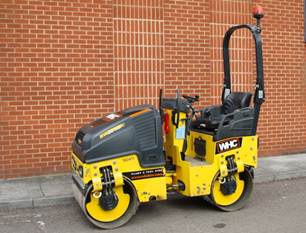
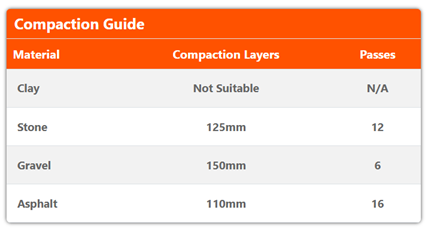
80 roller weighing 1550kg can compact crushed stone at 125mm layers but requires 12 passes to do so. Whereas…
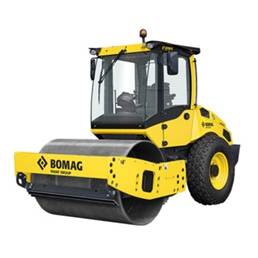
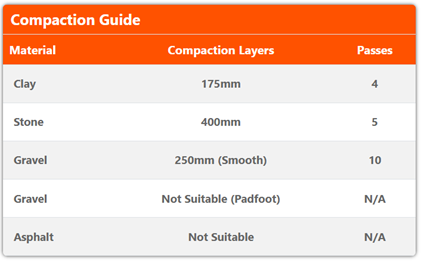
A 7T roller can compact the same material at deeper levels of 400m and requires only 5 passes.
Uses For Roller Compaction
Roller compaction is used industry-wide across the construction sector, from large-scale civil engineering works to smaller domestic and landscaping projects. Its application is essential whenever ground materials need stabilising to create a strong, durable base.
Some of the most common uses for roller compaction include:
Roads and highways
Used to compact sub-bases through to final capping layers such as asphalt, ensuring long-term structural integrity.
Driveways
Compacting soil and crushed stone to prevent movement and subsidence when vehicles are parked or driven over the surface.
Building foundations
Before installing footings, sub-bases are compacted in line with building regulations to support imposed loads.
Trench backfilling
Compressing backfilled trenches to improve stability and reduce the risk of settlement around services.
Ponds and lakes
Compacting pond and lake walls to minimise seepage and maintain structural integrity over time.
Across each application, roller compaction ensures that the ground can support the loads placed upon it without shifting or settling as time passes. This is particularly important for surfaces exposed to frequent traffic, heavy loads, or fluctuating forces.
Due to the wide variation in regulations and applications, many contractors opt for roller hire rather than purchasing equipment outright. This approach allows the most suitable roller to be selected for each project, without the long-term investment.
Types Of Different Roller Compaction
There are several types of rollers used for roller compaction, each designed to suit specific materials, site conditions, and finish requirements. However, selecting the correct roller is essential to achieving effective compaction and meeting project specifications.
Smooth Drum Rollers
Smooth drum rollers are ideal for compacting granular soils, crushed stone, and capping layers such as asphalt. Their smooth steel drums provide an even, smooth finish, making them one of the most commonly used rollers in road construction and surfacing projects.
Padfoot (Sheepsfoot) Rollers
Padfoot rollers are most commonly used on cohesive soils such as clay. Their raised pads knead the material, breaking down the soil and compacting it from the bottom up. This makes them particularly effective where deep compaction is required.
Tandem Rollers
Tandem rollers feature twin smooth drums and are ideal for creating smooth, consistent finishes. They are commonly used on asphalt and surface layers where a ripple-free, uniform finish is required.
Self-Propelled Rollers
Self-propelled rollers are designed to achieve deep, consistent compaction across a wide variety of materials and terrain. These machines are widely used in civil engineering works and large-scale construction projects.
Vibratory Rollers
Most modern compaction rollers are equipped with a vibratory setting, allowing operators to compact deeper layers more efficiently. Vibration increases compaction force, helping achieve density levels more quickly and with greater uniformity across the surface.
If you need help determining which roller is best suited to your project, see our guide to choosing the right roller, which breaks down equipment selection based on material type, site conditions, and project requirements.
Do I Need To Wet Soil Before Compaction
Moisture plays a crucial role in effective roller compaction. Soil that is too dry will not bind together properly, making it difficult to achieve the required density. On the other hand, soil that is too wet can become unstable, lose strength, and deform under load. Achieving the correct moisture balance is essential — but where is the sweet spot?
This balance is known as the Optimum Moisture Content (OMC). OMC varies depending on soil type, but in general, it represents the point at which soil can be compacted to its maximum density with the least effort. It is not a fixed percentage across all soils, but rather a condition where moisture and compaction energy are correctly balanced.
Simple Hand Test for Moisture Content
A quick on-site method for assessing moisture content is the hand test:
- Pick up a handful of soil or dirt
- Squeeze it firmly in your hand
- Observe how the material reacts
Too Wet:
The soil forms a dense, sticky ball and remains intact. Moisture may be visible on your hand, and in some cases, water may be released under pressure.
Just Right (Near Optimum Moisture):
The soil forms a ball when squeezed, but breaks into a few pieces or crumbles when lightly poked or dropped from a short height.
Too Dry:
The soil appears dusty or powdery and falls apart immediately when you open your hand.
Most professional roller compaction equipment is fitted with a water suppression or spray system. This allows operators to add moisture gradually during the compaction process. Adding water is important because it acts as a lubricant between particles, allowing the material to settle into a denser, more stable arrangement.
This is especially important when compacting cohesive materials such as clay, where correct moisture content significantly improves compaction results and long-term stability.
Disadvantages Of Roller Compaction
While roller compaction is a crucial stage in most construction and groundworks projects, it does have certain limitations that need to be considered and managed correctly.
Incorrect Roller Selection
One of the most common issues is selecting the wrong roller for the material being compacted. With a wide range of machine designs available, incorrect selection can easily occur, particularly when experience is limited. All operators should consult the manufacturer’s operating manual to confirm recommended compaction depths, vibration settings, and pass counts for each material type.
Poor Compaction Technique
Some operators rely on visual or “feel” indicators, continuing to roll until the surface appears stable. In reality, effective roller compaction is a precise process influenced by material type, moisture content, machine weight, vibration frequency, and the number of passes. Over-compaction can damage soil structure and lead to instability or future settlement issues. Following the machine’s compaction guide is essential to avoid problems later in the construction process.
Confined Spaces
Not all rollers are suitable for use in confined or restricted areas. In these situations, alternative compaction equipment such as wacker plates, trench rammers, or remote-controlled trench rollers may be required to achieve adequate compaction without compromising access or safety.
Vibration Restrictions
While vibratory rollers are highly effective, vibration use may be restricted when working close to existing buildings, utilities, or sensitive structures. In these cases, operators must ensure the roller can still be used in static (deadweight) mode to achieve the required compaction without causing structural damage.
All of these challenges can be effectively mitigated through experience, careful planning, and selecting the correct equipment via professional roller hire services, ensuring both compliance and long-term performance of the finished surface.
Why Choosing The Right Roller Matters
Roller compaction is, in many respects, both a technical discipline and an art form — and it remains a foundational requirement for successful construction and groundworks projects. Achieving effective compaction relies on correctly matching the machine to the material being compacted, site conditions and relevant building regulations.
Getting this balance right requires careful planning, technical understanding, and practical experience.
For a deeper insight into equipment selection, explore our guide to choosing the right tandem or self-propelled roller to hire, or visit WHC Hire’s range of compaction rollers for hire, where you’ll find detailed specifications and guidance to help you get started with confidence.