What Access Equipment Do You Need for Events?
When you’re planning a large scale event or festival, access equipment isn’t just an afterthought, it’s a core part of your event setup. Especially when it comes to building infrastructure. The wrong machine on the wrong ground, or the incorrect kit for a rigging system, and the whole structure can come crashing down. It doesn’t just slow crews down, it causes chaos on already tight deadlines.
The challenge isn’t simply understanding that you need access equipment, it’s getting clear on which equipment is right for the task at hand. In addition to finding a hire partner who genuinely understands the specific demands of outdoor events. Festival grounds are not construction sites. The terrain is different, the timelines are tighter and the consequences of getting it wrong are far more visible.
In this WHC Hire guide, we’ll break down the three core types of access equipment used across large events and festivals, and help you match the right machine to the right job. But first, let’s get clear on what we actually mean by access equipment in an events context.
What Is Access Equipment in an Events Context?
The term access equipment is broadly used to describe machinery that allows crews to safely work and operate at height. During events, this covers everything from installing lighting and AV on a rig above a main stage, to positioning structural components during a build.
For large outdoor events, the category narrows quickly. Crews are operating on ground that changes, in weather that can leave you up to your knees in mud, spread across multiple acres with no room for equipment that doesn’t make the cut. Especially when you’re dedicating a portion of your operational budget towards it. That rules out machinery that works perfectly well in a warehouse or on a level construction site.
The three machines that consistently deliver on outdoor event sites are telehandlers, rough terrain scissor lifts, and MEWPs such as trailer-mounted boom lifts. Each serves a purpose. Knowing where one ends and another begins separates a smooth build from a costly one.
Telehandlers
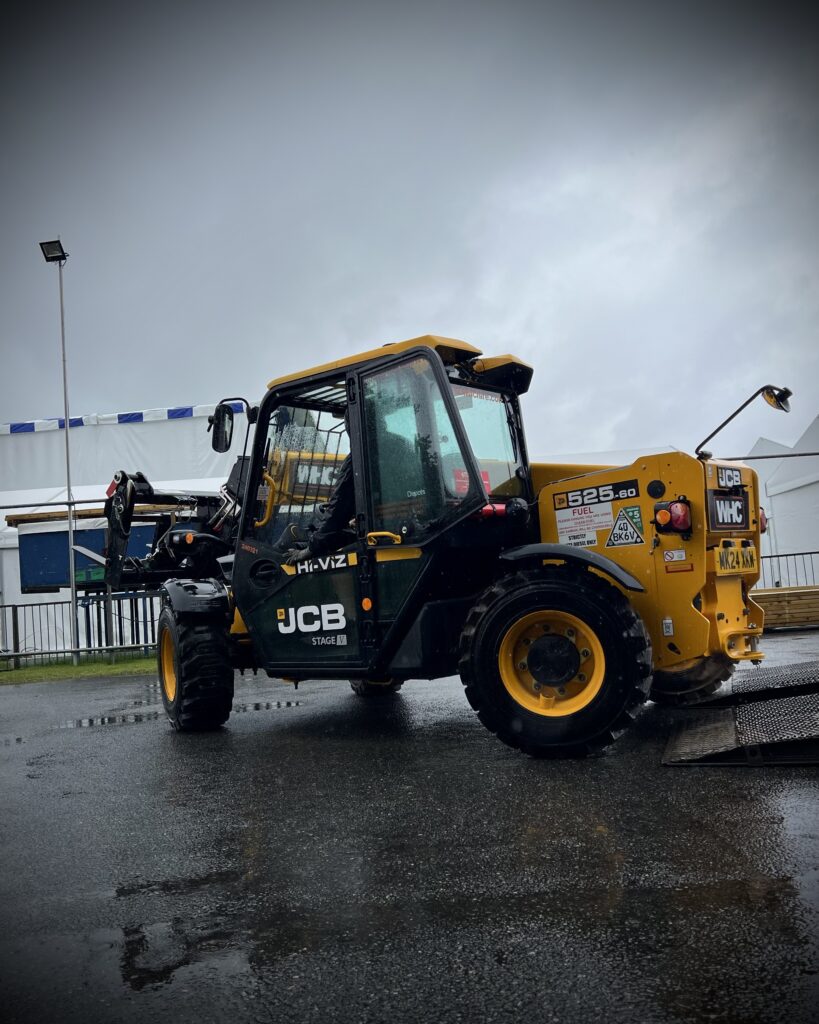
If there is one piece of machinery that is worth its weight in gold. It is a telehandler. However, it is worth noting that this is not the primary function of this machine. Let us explain.
A telehandler’s core function is lifting and placing heavy loads across a site. To operate as an access platform, you will require a personnel basket attachment.. A small but important detail that can easily be missed when planning your event equipment hire.
Where telehandlers genuinely earn their keep is through their versatility across multiple stages of your build delivery. If you are looking to make the most of your hire budget, be sure not to overlook this.
Before a lighting rig or event stage can even begin to take shape, someone needs to transport the components across site and get them into position. On large, uneven festival sites, that job falls to the telehandler. Unlike forklifts, which suit hardstanding surfaces, telehandlers handle the kind of terrain you will actually be dealing with.
On a festival build, telehandlers normally handle stage deck and steelwork positioning, generator and power distribution moves, crowd control barrier and temporary fencing layout, and loading and unloading at delivery zones. Add an access basket and the same machine now supports safe working at height across your site.
That combination of ground capability, lifting capacity and versatility makes the telehandler the most sought-after machine in events.
Rough Terrain Scissor Lifts

If telehandlers are the Swiss Army knife of site logistics, rough terrain scissor lifts are the backbone of working at height. On outdoor sites, the ‘rough terrain’ part is not something to overlook.
Standard scissor lifts are built for level, solid surfaces. Put one on a grassy field and you will soon find out you have picked wrong. Rough terrain scissor lifts handle the conditions outdoor events throw at them. Their wider wheelbase, four wheel drive, rough terrain tyres and outriggers make working on uneven ground safe and secure, whatever the weather does to your site overnight.
Rough terrain scissor lifts come into their own on tasks requiring a stable, elevated platform at a consistent working height. This makes them the go-to for installing lighting and audio rigs and fixing trussing at height.
Rough terrain scissor lifts handle heavier payloads than any other access equipment, meaning crews can work at height and lift essential equipment at the same time. This makes them ideal for signage, banners, large-format graphics and AV installations across stage and front-of-house positions.
On a tight build schedule, putting two, three or more crew members and their equipment to work simultaneously can directly cut the time it takes to bring rigs and stages together.
For a closer look at how rough terrain scissor lifts perform specifically in a lighting and rigging context, check out our guide to Access Equipment for Lighting and Rigging.
Boom Lifts (MEWPS)
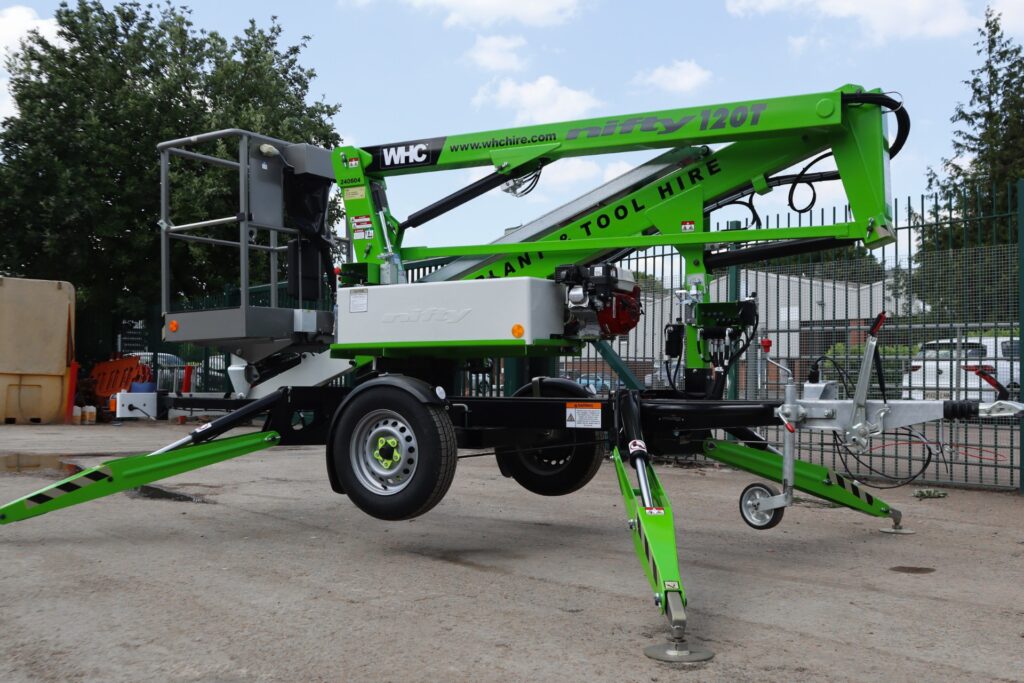
When event setup tasks require both height and outreach, scissor lifts no longer rule the roost. In these scenarios, a boom lift or MEWP is your answer. These machines are often deployed for the most demanding tasks on a festival site, especially where height is crucial and access is awkward.
Boom lifts extend both vertically and horizontally, giving crews far more from a single working position. Their articulating reach gets crew members over obstacles, around structures and into positions that scissor lifts and telehandlers could never reach.
In a real festival context, this means a crew member can rig above a roof structure, a camera operator can shoot with an unobstructed view across the crowd, or a maintenance team can service sound and lighting equipment during a live event without disturbing the structure below.
Trailer-mounted designs are particularly worth highlighting for event organisers. Unlike self-propelled units, trailer-mounted boom lifts can be towed directly into working position regardless of ground conditions. Arguably the most practical advantage of all is that you need no specialised machinery to do so. Most trailer-mounted designs work with 4×4 vehicles, ATVs and some telehandler configurations, making them exceptionally versatile.
Boom lifts also work beyond the build and construction phases of your event. They provide a stable platform for camera operators, broadcast equipment and aerial amenities during live events.
Whether you are rigging a main stage, installing a screen or managing a multi-stage site, a trailer-mounted boom lift delivers the reach your most demanding access tasks require.
Choosing The Right Machine For The Right Task
Many event organisers understand each of these machines individually, but knowing how they work together across multiple phases of a build is often where the real value lies. The most efficient builds treat access equipment scheduling with the same detail as event production itself.
Here is how the three machines map across the most common tasks on a large outdoor event site.
Telehandler
Best suited to site logistics as its primary function, enabling event crews to quickly position heavy structural components and essential equipment across site. Add an access basket and the telehandler steps into a versatile high-reaching machine. Remember that telehandlers offer horizontal and upward movement, not purely vertical. An essential consideration for many event build tasks.
Rough Terrain Scissor Lift
Best suited to tasks that require vertical elevation only. Supported by their rough terrain features, these machines enable the safe installation of heavy equipment at height across outdoor sites. Their platform capacity allows multiple crew members to work from the basket simultaneously, making them a strong choice for working at height. However, they do not offer horizontal movement.
Trailer-Mounted Boom Lift
For complex aerial tasks, the trailer-mounted boom lift supports both working at height and outreach. Basket load capacities are lower than a scissor lift, but it enables far more flexibility across the variety of tasks a live event demands. Its towing capability also makes it the most mobile machine across a large or multi-stage site.
For larger festival sites, the answer is rarely just one machine. Each piece of equipment has its limits, and stretching any machine beyond them creates serious safety risks. Operating each machine where it performs best improves efficiency and significantly reduces the chances of accidents on site.
Outdoor Terrian Changes Everything
The biggest variable on an outdoor festival site is not the schedule, the crew or the weather. It is the ground beneath your feet. When choosing access equipment, site ground condition is the single most important factor. And things can change unexpectedly.
Outdoor event grounds are rarely even or static. A firm, manageable space can look entirely different after a few hours of rain or after vehicles have tracked across it.
Soft ground, rutted tracks and waterlogged fields create logistical headaches and genuine safety risks for access equipment not specified for those conditions.
This is why when selecting access equipment to hire for an outdoor event, rough terrain capability is not optional. It is an essential requirement. Machines built for these conditions run all terrain tyres and outriggers, providing the stability needed on unpredictable ground.
Working At Height Safely At Events
You will notice this guide steers you towards choosing the safest access equipment for your event. And for good reason. The majority of fatalities that occur involving access equipment are as a result of falling from height. It is therefore essential that the people operating these machines are competent and compliant to do so.
From a legal standpoint, when onboarding event equipment hire machinery, keeping yourself, your staff and your build schedule protected should be a priority.
In the UK, working at height is governed by the Work at Height Regulations 2005. These place a clear duty of care on event organisers and production companies to ensure that any work carried out at height is properly planned, appropriately supervised and undertaken by people with the competence to carry it out safely. On an outdoor festival site, that responsibility sits firmly with you as the event organiser.
While you don’t need to prove competence to hire access equipment, we strongly recommend that any staff operating the machinery are trained to do so. IPAF, the International Powered Access Federation, is the most widely recognised training provider in the UK for powered access equipment
For event contractors specifically, larger multi-party event sites may require copies of operator training certification before access equipment can be used. It is a detail that is easily overlooked in the middle of a busy production schedule, and one that can cause serious setbacks to your timeline.
For a full breakdown of your responsibilities during both the build and live phases of your event, take a look at our guide to “Working At Height Safely At Events”
How Much Access Equipment Does Your Event Need
This is one of the most common questions we get asked, and the answer depends on a wide range of factors. Each event is different, they have their own needs and each production team tends to have their preferred methods. Addressing these key factors can heavily influence how much access equipment your teams should be onboarding to deliver a large outdoor event or festival.
Site Footprint
The larger the site, the more machines you will likely need. Unfortunately, even now the power of teleportation is still not available. Multiple machines operating across different areas of the site simultaneously boosts production and progress. Trying to conduct too many tasks with a single machine can often lead to delays, especially on tight deadlines.
Number of Stages and Structures
Each stage, performance area or temporary structure can benefit from its own piece of access equipment specific to the task at hand. In some scenarios a mix of machinery working in combination can offer the safest and most efficient solution for stage building alone.
Build Window
Some of the largest events welcome a two to three week build window. Others in as little as a single day. The scope of build windows is huge depending on the site requirements of your event. Where tighter schedules are involved, running multiple pieces of access equipment simultaneously can enable crews to hit their production deadlines.
Crew Size
Larger crews can make better use of multiple machines working in parallel across a large event site. However, for smaller event teams running only a handful of crew members, hiring multiple machines at once can lead to unnecessary spend when equipment is sitting idle.
If you are unsure of where to start, the best approach is to map out your access equipment hire requirements against your production schedule. You can then share this with your event equipment hire supplier, who can ensure the right machinery arrives exactly when you need it, specific to each task.
In turn, this ensures you get the right equipment, in the right place, at the right time.
Why Hire Access Equipment Rather Than Buy?
For most event organisers, the question of whether to buy or hire access equipment for event crews does not take long to shed light on. Most large events only take place once a year, of which the planning starts on the first day of breakdown. In short, most event crews have no need for owning their own machinery throughout the year. And even for crews that move around the UK, hiring and having machinery delivered removes just one more headache from the already complex task of event logistics.
Nevertheless, here are the main reasons why most event contractors favour hiring:
Cost
When event crews choose to hire, they only pay for the machinery for the period they require it. With flexible hire durations, event production businesses save significantly on obtaining the equipment they need to work safely. Tying up capital in machinery that depreciates simply does not stack up financially. Hiring gives teams access to the exact machines they need, for the exact period they need them, without the overhead.
Access to the Right Machine for Every Event
As we have already discovered, the right machinery is essential for specific tasks and no two events are the same. A machine that was perfect for last summer’s event will not necessarily stand up in this year’s boggy ground. Hiring gives crews quick access to the specific machinery that matches the needs of the production, taking into account ground conditions and requirements, rather than just using what you own and winging it.
Maintenance and Compliance
Another responsibility that event teams easily overlook is machinery maintenance and compliance..If you own your own equipment, you are solely responsible for its upkeep. In the case of access equipment, that includes LOLER inspections every six months. Hiring removes the significant administrative paperwork, time and cost of ownership that buyers often gloss over at the point of purchase.
Availability and Logistics
A good hire supplier will provide you with the machinery. A great hire partner will do far more. Working with a reputable event equipment hire company ensures you get the most suitable machinery for the task at hand. And when it is showtime, they will deliver the equipment, support your setup and breakdown, and respond quickly if your requirements change or assistance is needed on site. That level of logistical support is something ownership simply cannot offer.
If you are planning a large outdoor event or festival and want to discuss your event equipment hire requirements, we would love to help. Speak to the team at WHC Hire Services and let us help build the right equipment package and schedule to deliver an unforgettable event.
FAQ’S
What access equipment is most commonly used at festivals and larger outdoor events?
For most large events, the most commonly used pieces of access equipment to use are rough terrian scissor lifts and MEWPS such as boom lifts. In addition, highly versatile machinery like telehandlers can double up as access equipment when paired with a basket attachment. On larger sites all three machines can be deployed to be use simutalitous across different tasks.
Do I need IPAF certification to hire access equipment for an event?
No you do not need to prove your crew member hold an IPAF certification to hire access equipment for your event. However, it is strongly recommended that any operators using MEWPs such as scissor lifts and boom lifts on your event site hold a current IPAF PAL card. On larger multi-party event sites, proof of operator certification may be a condition of site access. The Work at Height Regulations 2005 place a clear duty of care on event organisers to ensure that all work at height is carried out by competent personnel.
Can rough terrain scissor lifts be used on grass?
Yes. Unlike standard scissor lifts which are designed for level hardstanding surfaces, rough terrain scissor lifts are specifically engineered for outdoor use on uneven and soft ground. They are fitted with all terrain tyres, four wheel drive capability and outriggers to provide stability across the kind of ground conditions commonly found on outdoor festival sites, including grass, mud and uneven terrain.
How far in advance should I hire access equipment for a festival?
As early as possible. Peak festival season in the UK runs from late spring through to early autumn, and demand for specialist outdoor event access equipment during this period is high. We would recommend confirming your access equipment hire as soon as your production schedule and site plan are in place. For larger multi-stage events, getting your equipment schedule confirmed several months in advance ensures availability and gives your hire partner enough time to plan delivery and logistics around your build programme.