ATV, Telehandler, or Both? Choosing the Right Equipment to Move Kit Around Your Event Site

Every major event, whether it is a summer festival, country show, or corporate exhibition, relies on crucial logistical equipment behind the scenes to deliver the showcase. And should that crew be supplied with the wrong equipment to do so? The answer is a logistical nightmare. Ultimately, one small mishap here and you should expect delays to your build, delays to breakdown, and a lot more extra manual labour that nobody budgeted for.
Two of the most popular pieces of event equipment hire we are asked about are ATVs and telehandlers. Both solve different problems, and in many cases the right answer is not one or the other, but both.
This WHC Hire guide looks at what each machine is, where it best fits, and how to work out the right mix for your next event. By the end, you will be confident to secure the right equipment ready to deliver your next unforgettable event.
What Is an ATV and What Is a Telehandler?
Before we jump into which machine suits which job, it helps to know exactly what we are talking about.

An ATV, or all-terrain vehicle, is a compact off-road vehicle built to cross uneven, muddy terrain with ease. Their design enables the movement of multiple crew members and equipment all at the same time. On event sites, they are the fastest way to get from one end of a showground to the other, especially when that ground was never meant to carry vehicles.
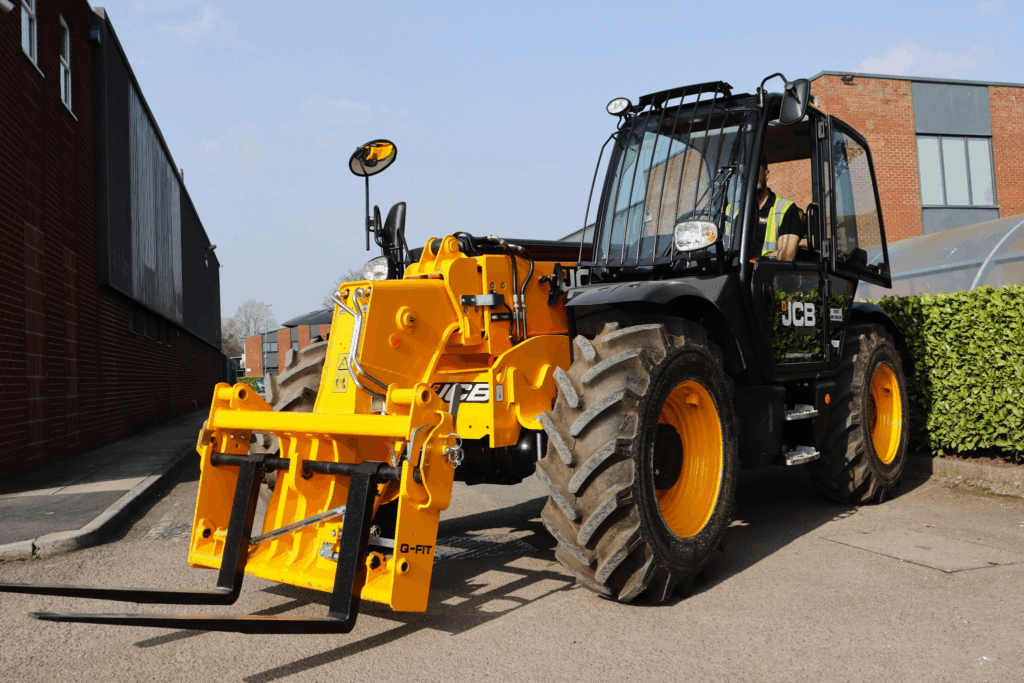
A telehandler, on the other hand, is a heavy-duty machine fitted with an extendable boom that lifts, carries, and places loads at height and at reach. Think of it as a cross between a forklift and a crane, best suited for transporting heavy structural work that multiple crew members would struggle to move by hand. From staging sections and marquee frames to palletised deliveries arriving on site, a telehandler turns a job that would take a full team hours of manual handling into a task one operator can complete in a fraction of the time.
Why Equipment Choice Matters for Event Logistics
Getting your equipment choice right at the planning stage pays off long before your event gates open. Reputable event organisers know this, yet it is still astonishing how many fail to opt for the most efficient machinery to help.
The right equipment on site means less manual handling for your crew, which not only reduces the risk of injury, but also keeps the cost of staff down too. For crew members, it also keeps them fresh, less fatigued, and more optimal when working under tight deadlines. It also means faster build and breakdown times, since the equipment is built for the job, allowing your teams to complete their tasks in a fraction of the time compared to the manual approach.
In addition to speed, the right equipment protects the site itself. ATVs are built for rough terrain, which avoids the vehicle damaging the underlying surface it is operating on, or the delays that come from using the wrong transport on uneven ground. Whereas a telehandler with the correct lift height and load capacity can avoid the risk of overloading or straining equipment that was never designed for the job.
Ultimately, the equipment you onboard for your event has a direct impact on your timeline, budget, and the safety of the crew working on site.
ATVs For Festivals & Events

ATVs have become a revolutionary way for many modern events to maximise speed and access. A utility ATV can quickly cover a large distance over rough or wet terrain, faster than a crew member on foot. This makes transport on event sites far more reliable and effortless compared to a standard vehicle that is not necessarily meant for working in those conditions.
During events, ATVs are used for:
- Moving crew members and small teams around large sites quickly
- Transporting tools, radios, and lightweight equipment, reducing manual handling
- Getting medical or security staff to remote areas quickly in response to an emergency
- Conducting site inspections before, during, and after the event
However, even with all their benefits, it is important to understand their limitations. ATVs are more of a mobility solution rather than a material handling one. Therefore, once you are dealing with transporting staging sections, pallets, structural components, or heavy rigging gear, you may need something with genuine lift capacity.
For a closer look at why these vehicles have become a staple of festival and country show logistics, see our guide on why ATVs are essential for festival site management.
Telehandlers For Festival & Events

Telehandlers, on the other hand, are built for exactly the jobs that ATVs cannot do. Their telescopic boom allows crew members to lift, transport, and place heavy loads with ease. With their extendable lift height, they also remove the need for additional lifting equipment when installing or breaking down event equipment. This alone makes them a familiar sight during the set up and load out phases of most large events.
Common tasks telehandlers are used for include:
- Lifting and positioning staging equipment and marquee structures
- Moving palletised deliveries around site without manual handling
- Loading and unloading vehicles
- Placing lighting and sound equipment at height
- Transporting security fencing for securing the site
- Towing other machinery such as tower lights and welfare units
It is worth noting that telehandlers come in a range of sizes and capacities. The model you choose will depend entirely on the size, scale, and required lift capacity of the particular task you have planned. Compact models are best suited for smaller sites where access is much tighter, while larger events with bigger structures require a machine with greater reach and lift.
Need help selecting the right telehandler for your event? We have packaged everything you need to know in our other resource: What size telehandler do you need for your event?
ATVS vs Telehandlers: Overview
| ATV | Telehandler | |
| Best For | Crew members and lightweight equipment | Lifting and transporting heavy loads |
| Load Example | Crew members, tools, signage, light kit | Pallets, staging components, tower lighting, rigging, security fencing |
| Terrian | All-terrain capabilities | All-terrain capabilities |
| Lift Capacity | None | Significant depending on the model. |
| Towing Capacity | Lightweight trailers up to 450kg | Tow tower lights, welfare units and similar-sized equipment. |
| Speed | Fast | Slow/ Medium |
| Event Phase Used | All stages of events | All stages of events, but mainly build and breakdown. |
| Operator Requirements | Site briefing, driver’s licence when used on public roads | An NPORS card is usually required to prove competency. |
Decision Factors Checklist: ATV vs Telehandler
One thing is for certain, once you are in the middle of your build and the clock is ticking, you want to ensure you have the right equipment to get the job done. Whether you are considering onboarding an ATV, telehandler, or even both, use this checklist before booking your machine with your event equipment hire specialist.
1. Project Scale
Know exactly what you want to move, and how often, across each phase of the event build, breakdown, and live running. This ensures you have the correct amount of muscle to complete your tasks swiftly and effortlessly.
2. Terrain
Is the site flat? Rough? Are there any underfoot considerations you need to make when choosing the most suitable machinery? While both machines are able to work on soft ground, it is worth noting any ground load capacities you need to consider, as heavier machinery can easily sink on wetter sites.
3. Access Constraints
How tight are the routes between compounds, stages, and other site areas? Knowing this will help you select the right size of machinery.
4. Load Type
What are you planning to move with the equipment? Is it people and small kit, or heavy structures, pallets, and other equipment?
5. Operator Experience
Is the person operating the equipment competent to do so, and are they able to prove it with accredited licensing, for example NPORS?
6. Transport Logistics
How far are you transporting the equipment, and have you planned how many trips it may take to complete the task?
7. Timing
When is each machine needed? There is no need to have everything on site at once if it is not being used. Staggering your delivery can help save on hire costs.
Working through each of these factors before you book your equipment helps avoid the most common mistakes of hiring the wrong machinery for your site. If you are ever unsure, working closely with an event equipment hire specialist can ensure you get the most efficient machinery for your budget, delivered as your event unfolds.
When You Need Both
For large events and country shows, the choice is rarely either/or when it comes to ATVs and telehandlers. In truth, these machines are usually harnessed for their strengths in delivering results in different areas. A festival build might use telehandlers during the early parts of the build to transport and build staging and structural components, whereas an ATV will be used to transport crew members from designated welfare areas and throughout live operation. More so, during live operation, ATVs provide fast response times to security breaches and medical emergencies should problems occur.
Hiring both machines from the same supplier keeps logistics simple and far more cost-effective. Where possible, having all the equipment arrive together on the same delivery schedule, with a single point of contact, streamlines your entire operation.
Dos & Don’ts of Hiring An ATV or Telehandler For Your Event.
Here are simple do’s and don’ts when hiring either an ATV or telehandler for your event this season.
Do’s
- Book your equipment and delivery early to secure what you need. Machinery used on events is in high demand throughout peak times of the year.
- Ensure your team are trained and competent to operate the machinery you have hired.
- Always perform daily inspections of the equipment to ensure it is working correctly.
- Brief ATV drivers on site rules and terrain hazards before use.
- Regularly check the weather and ground conditions, in case alternative equipment may be required.
- Plan delivery and collection of your equipment around your build, live, and breakdown phases to avoid any unnecessary hire costs.
Don’ts
- Assume all crew members are competent to operate lifting equipment without the correct certification.
- Use ATVs to tow heavy loads beyond their designated capacity.
- Overbook machinery for phases of the event where it will sit unused.
- Forget to insure the machinery while it is on hire. You will be solely responsible for it while it is in your possession.
Licencing & Safety Considerations
While you do not need an operator’s licence to hire either a telehandler or ATV, it is worth checking that the personnel responsible for using them are competent to do so. The last thing you need is your event coming to a grinding halt due to a breach of health and safety.
But the question is, how do you prove competence on each particular machine in a commercial setup?
Telehandlers
During events, telehandlers should only be operated by competent operators. This is usually proved through holding a CPCS or NPORS card for the specific category of machine being used. If you do not have a trained operator in house, you can access fast professional training from providers like Vally Plant Training, who specialise in industry recognised training courses to enhance your team’s safety.
ATVs
Unlike telehandlers, ATVs are more flexible when it comes to operational responsibilities. Anyone operating one on site should receive a safety briefing and be competent to do so. However, where an ATV is used on a public road, a valid driving licence is required. Another point to consider is insurance. Some providers will restrict the age limit for using ATVs on site or on the road, which could be something to factor in when multiple crew members are using the vehicle across a shift pattern.
Ensuring the correct licensing and safety measures are in place before ordering your event hire equipment can help simplify and protect your team during the busy build, operation, and breakdown phases of your event.
Hire Duration & Cost Factors
Machine size, hire duration, delivery charges, and cleaning and fuel charges, where applicable, are all part of the overall total cost for event hire equipment like this. Telehandler pricing generally scales as lift height and capacity increase. You can expect smaller, more compact units to cost less than high-reach machines needed for larger structures.
When it comes to ATVs, the cost is normally priced per vehicle per day or week, with costs increasing where multiple units are needed or road usage is required. ATVs used on the road must be road taxed, so it is essential to state this when hiring your equipment. Should this be needed, you can expect a small additional fee to tax the equipment.
When confirming your quote with your event equipment hire supplier, be sure that any additional attachments, delivery, and collection are included as part of your quote. Hiring multiple pieces of equipment from a single supplier can streamline your entire event delivery.
Getting the Right Mix for Your Event

Every event site has different needs, different requirements, and combinations of equipment. But the truth is, choosing the right equipment comes down to the size of your working site, what you are moving, and the ground conditions you are working on.
Whether that is simply speeding up your crew’s transit time from welfare zones to compounds, undertaking heavy lifting of stage components, or transporting palletised goods, having the right machinery working together across your build is essential. At WHC Hire Services, we help put together the right equipment for your event.
Get in touch with our team today to talk through your site, discuss your requirements, and build your tailored event equipment hire package.